
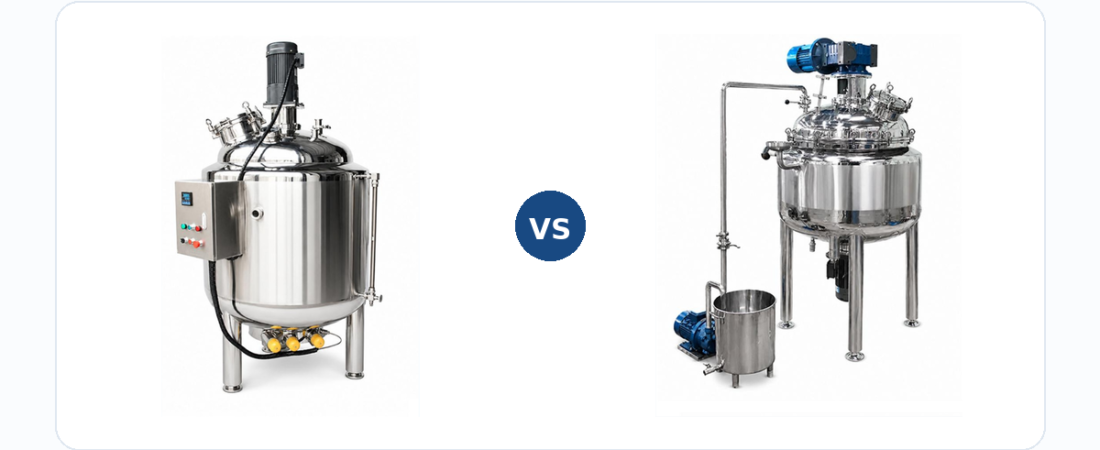
Choosing between a mixing tank and an emulsifying tank depends on what your product needs to achieve. A standard mixing tank is suitable for blending, dissolving and maintaining product uniformity, while an emulsifying tank uses higher shear forces to disperse, homogenize or emulsify materials more effectively. Understanding the difference can help you select the right equipment without adding unnecessary complexity or cost.
Mixing Tank vs Emulsifying Tank: Quick Comparison
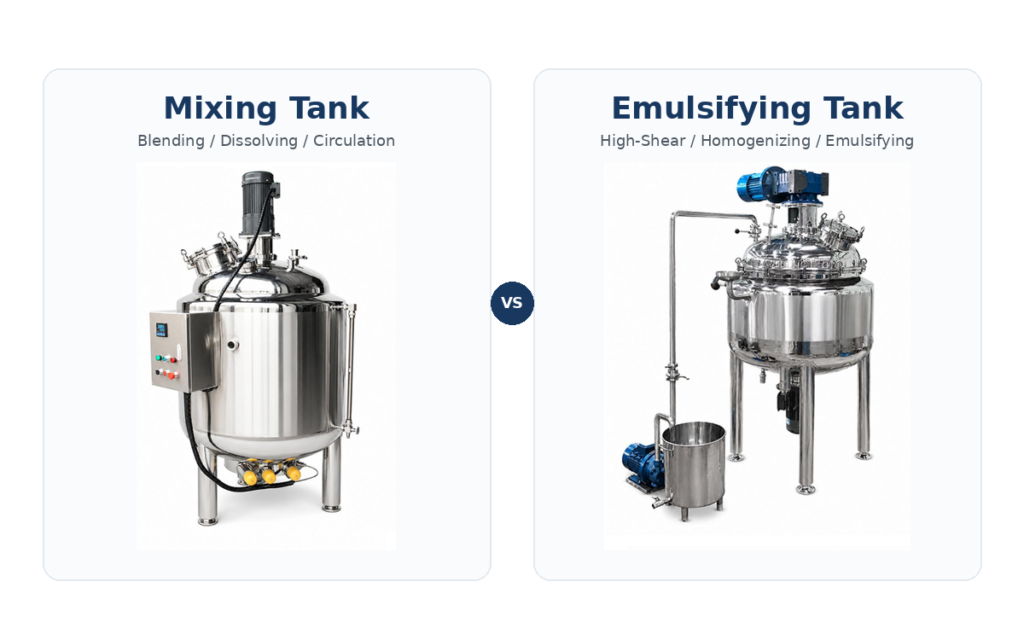
The main difference is the level of shear and the processing result required. A mixing tank is mainly used to blend, dissolve or circulate materials, while an emulsifying tank is designed for more intensive processing such as dispersion, homogenization and emulsification.
| Selection Factor | Mixing Tank | Emulsifying Tank |
|---|---|---|
| Main Function | Blending and dissolving | Emulsifying and homogenizing |
| Shear Level | Low to medium | High |
| Typical Products | Liquids and simple blends | Creams, sauces and emulsions |
| Mixing System | Agitator / impeller | Agitator + high-shear homogenizer |
| Particle Reduction | Limited | More effective |
| Vacuum Option | Optional | Common for some processes |
What Is a Mixing Tank?
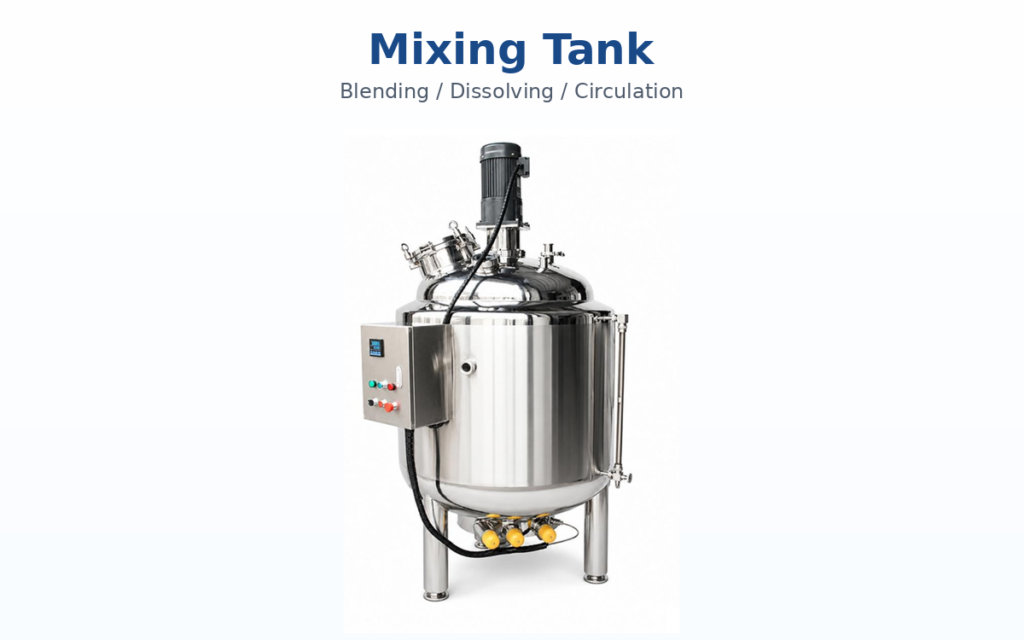
A mixing tank is designed to combine, dissolve or circulate liquid and solid ingredients into a uniform mixture. Depending on the process, it can be equipped with different agitators, variable-speed control, heating or cooling jackets, and sanitary connections.
Mixing tanks are commonly used when the main objective is consistent blending rather than intensive particle size reduction or emulsification. Typical applications include beverages, syrups, detergents, liquid foods and other general processing operations.
What Is an Emulsifying Tank?
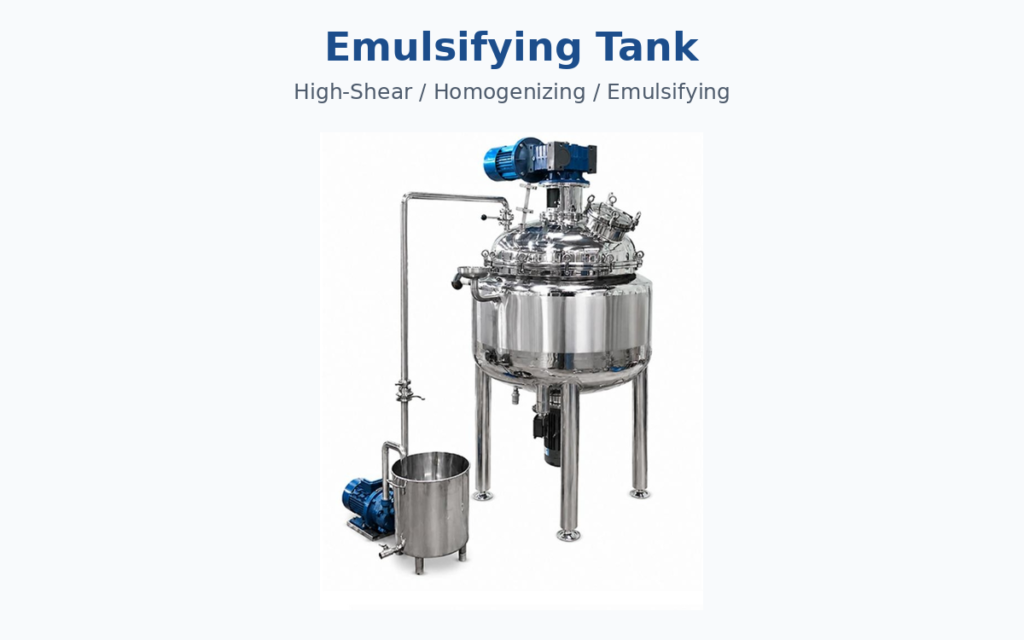
An emulsifying tank is designed for processes that require stronger shear forces than conventional mixing. It typically combines an agitator with a high-shear homogenizer to break down droplets or particles and create a finer, more uniform mixture.
This type of equipment is commonly used for products such as creams, lotions, sauces, mayonnaise and other oil-water emulsions where simple agitation may not provide the required stability or texture.
How Does High-Shear Emulsification Work?
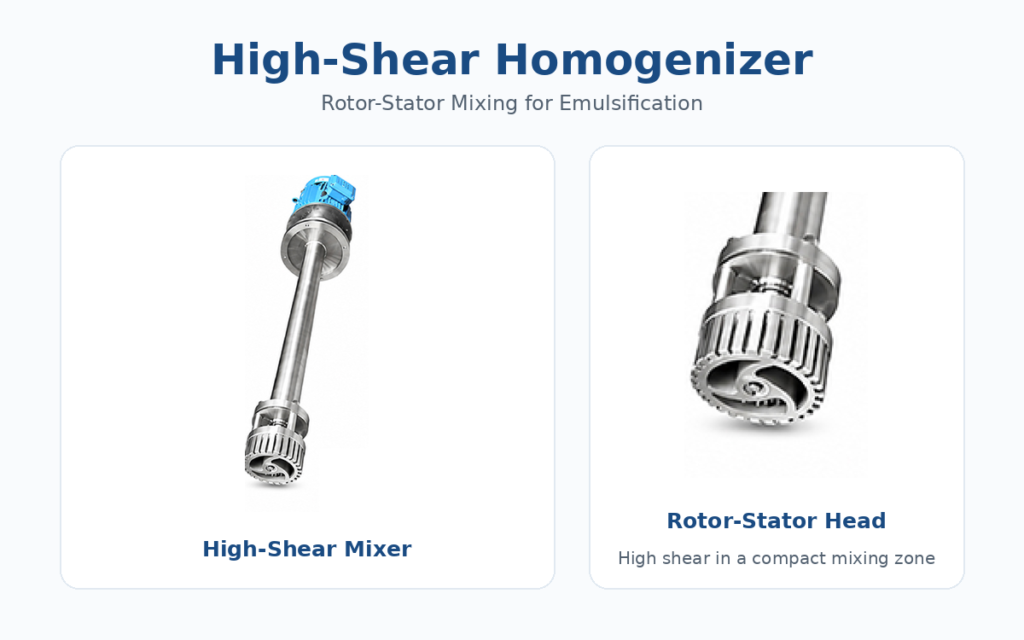
High-shear emulsification uses a rapidly rotating rotor and a stationary stator to create intense shear forces in a small processing zone. As the product passes through this area, larger droplets or particles are broken into smaller sizes and distributed more evenly throughout the mixture.
Compared with conventional agitation, this process is better suited to applications that require fine dispersion, stable emulsions or a smoother and more consistent product texture.
When Is a Mixing Tank Enough?
A standard mixing tank is usually sufficient when the process mainly requires blending, dissolving or maintaining a uniform liquid mixture. It is often the simpler and more economical choice when intensive particle reduction or emulsification is not required.
Typical applications include beverages, syrups, detergents, liquid seasonings and other low- to medium-viscosity products. The agitator type and mixing speed can be selected according to the product viscosity and processing requirements.
In general, if your ingredients can be mixed uniformly with conventional agitation and the product does not require a very fine emulsion or dispersion, a mixing tank is usually the more practical choice.
When Do You Need an Emulsifying Tank?
An emulsifying tank is a better choice when the process requires more than simple blending. It is particularly useful when two phases, such as oil and water, must be combined into a stable and uniform product.
High-shear homogenization can help reduce droplet or particle size, improve dispersion and create a smoother product texture. Typical applications include creams, lotions, mayonnaise, sauces, cosmetic products and other emulsified formulations.
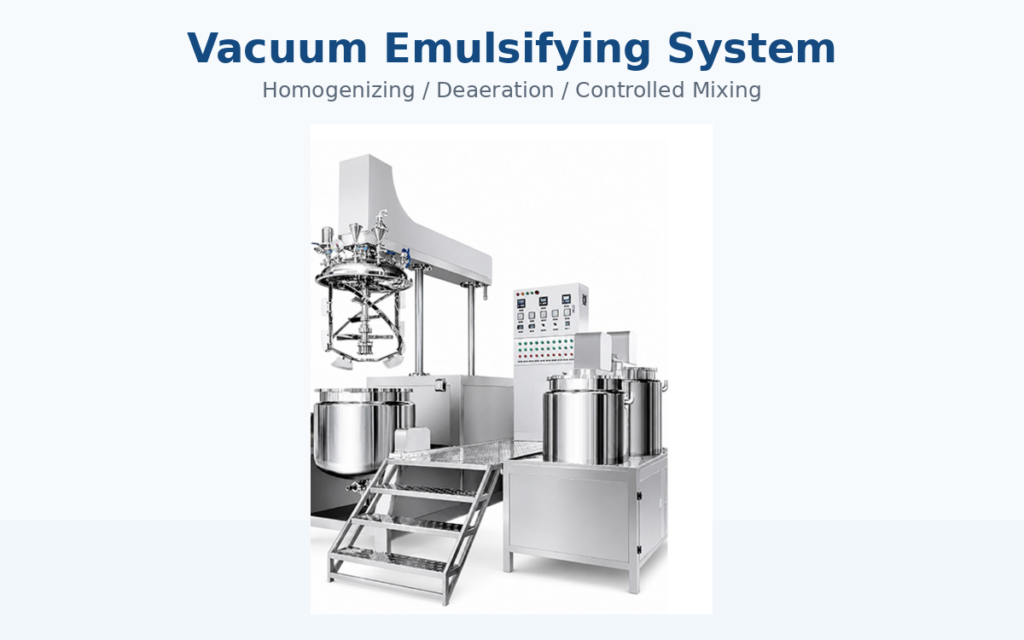
If the process is sensitive to air bubbles or requires deaeration during mixing, a vacuum emulsifying system may also be considered. The final configuration should be selected according to product viscosity, batch size and the required processing result.
How to Choose Between a Mixing Tank and an Emulsifying Tank?
The right choice depends on the product, processing objective and required final result. Before selecting the equipment, consider the following four factors.
1. Processing Goal
Choose a mixing tank for general blending and dissolving. Choose an emulsifying tank when fine dispersion, homogenization or emulsification is required.
2. Product Viscosity
Low- to medium-viscosity liquids can often be handled with conventional agitation, while thicker or more difficult formulations may require a stronger mixing system.
3. Product Structure
If oil and water phases must be combined into a stable emulsion, a high-shear homogenizer is usually more suitable than a standard agitator.
4. Vacuum Requirement
If air removal, reduced foaming or deaeration is important to the process, a vacuum emulsifying system can be considered.
What Information Should You Send the Manufacturer?
To recommend the right mixing or emulsifying equipment, the manufacturer needs some basic information about your product and production process. Providing these details early can make equipment selection faster and more accurate.
1. Product Type
Describe the material you plan to process, such as beverages, sauces, creams, detergents or other liquid products.
2. Batch Capacity
Provide the required working volume or batch size, for example 500 L, 1,000 L or 2,000 L per batch.
3. Product Viscosity
If possible, provide the approximate viscosity or describe whether the product is water-like, medium-viscosity or highly viscous.
4. Processing Requirements
Indicate whether you need simple mixing, powder dissolving, heating, cooling, homogenization, emulsification or vacuum deaeration.
5. Material and Controls
Specify any requirements for stainless steel grade, variable-speed control, temperature control or other customized features.
If some of these details are not yet confirmed, a product sample, formulation description or current process information can also help the equipment manufacturer recommend a suitable configuration.
Frequently Asked Questions
1. Can a mixing tank be equipped with a homogenizer?
Yes. Depending on the process, a mixing tank can be configured with a high-shear homogenizer in addition to the main agitator. The final configuration should be selected according to the product and required mixing result.
2. Is an emulsifying tank always better than a mixing tank?
No. For simple blending, dissolving or circulation, a standard mixing tank is often sufficient. An emulsifying tank is more suitable when the process requires high shear, fine dispersion or a stable emulsion.
3. Do I need a vacuum emulsifying tank?
Vacuum is useful when the process requires deaeration, reduced foaming or better control of air incorporation. It is not necessary for every emulsifying application.
4. Can mixing and emulsifying tanks be heated or cooled?
Yes. Both types of tanks can be designed with heating or cooling jackets when temperature control is required during the process.
Need Help Choosing the Right Tank?
The right equipment depends on your product, batch capacity, viscosity and processing requirements. Share your application details with us, and we can help recommend a suitable mixing or emulsifying configuration for your process.