
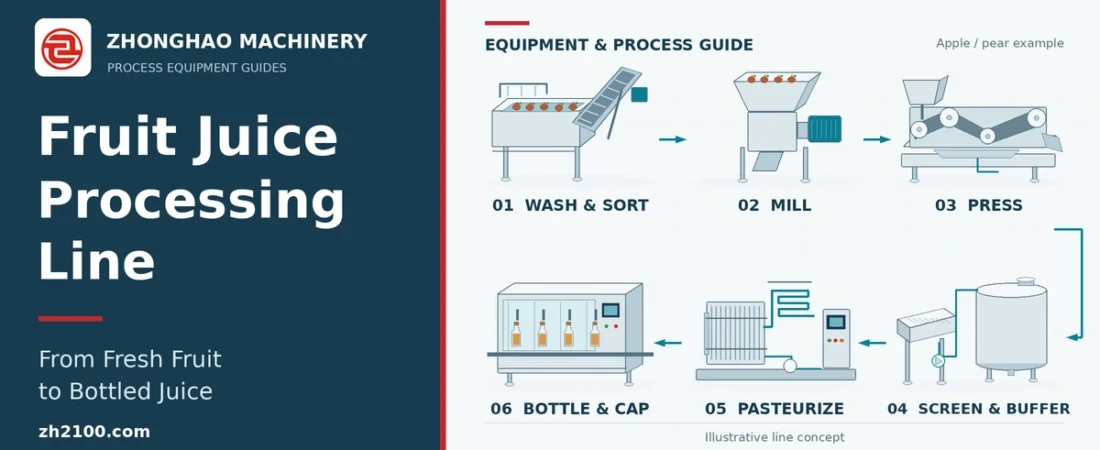
A fruit juice processing line brings several operations together: preparing the fruit, extracting the juice, treating the liquid and packing the finished product. Each machine has a role, but the project also depends on how material moves between machines.
This guide follows an apple and pear pressing route with hot-fill bottling. It explains the main equipment and the information needed to plan a suitable system. Other fruits, juice styles and packaging methods can require a different configuration.
What Equipment Is Included in a Fruit Juice Processing Line?
Start with a system overview so that the equipment list follows the product from intake to dispatch. The illustration below groups the line into nine equipment stages.
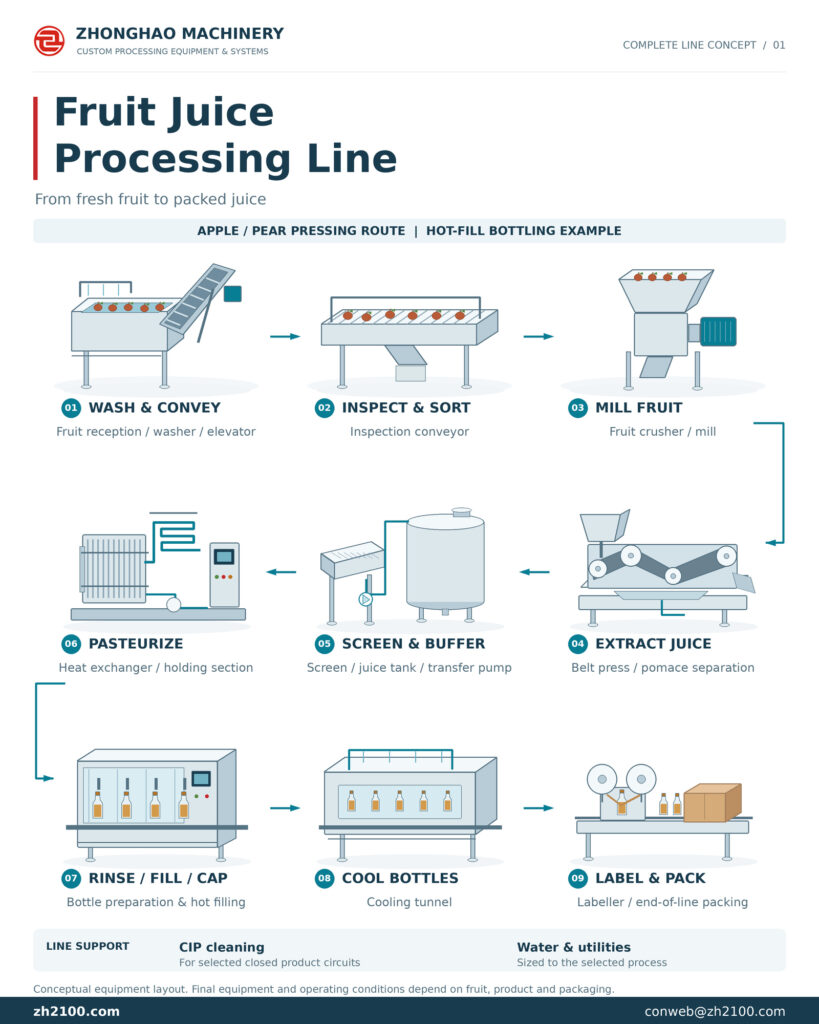
| Stage | Main equipment | Purpose in the illustrated line |
|---|---|---|
| 01 | Fruit reception, washer and elevator | Receive, wash and convey fruit to inspection. |
| 02 | Inspection conveyor | Provide an inspection point for sorting. |
| 03 | Fruit crusher or mill | Prepare the fruit mash for pressing. |
| 04 | Juice press | Separate juice from the solid pomace stream. |
| 05 | Screen, buffer tank and transfer pump | Remove coarse material and manage upstream juice transfer. |
| 06 | Pasteurization system | Apply the selected heat treatment and holding step. |
| 07 | Bottle rinser, filler and capper | Prepare compatible bottles, fill and close them. |
| 08 | Bottle cooling equipment | Cool the sealed bottles according to the packaging process. |
| 09 | Labeling and packing equipment | Label and prepare finished bottles for handling. |
The complete project also needs defined connections, cleaning arrangements, controls and utilities. These should appear in the project scope alongside the main machines.
How Does Fresh Fruit Become Bottled Juice?
The process diagram explains the same example in five groups. Read it together with the equipment overview to see both the flow and the function of each section.
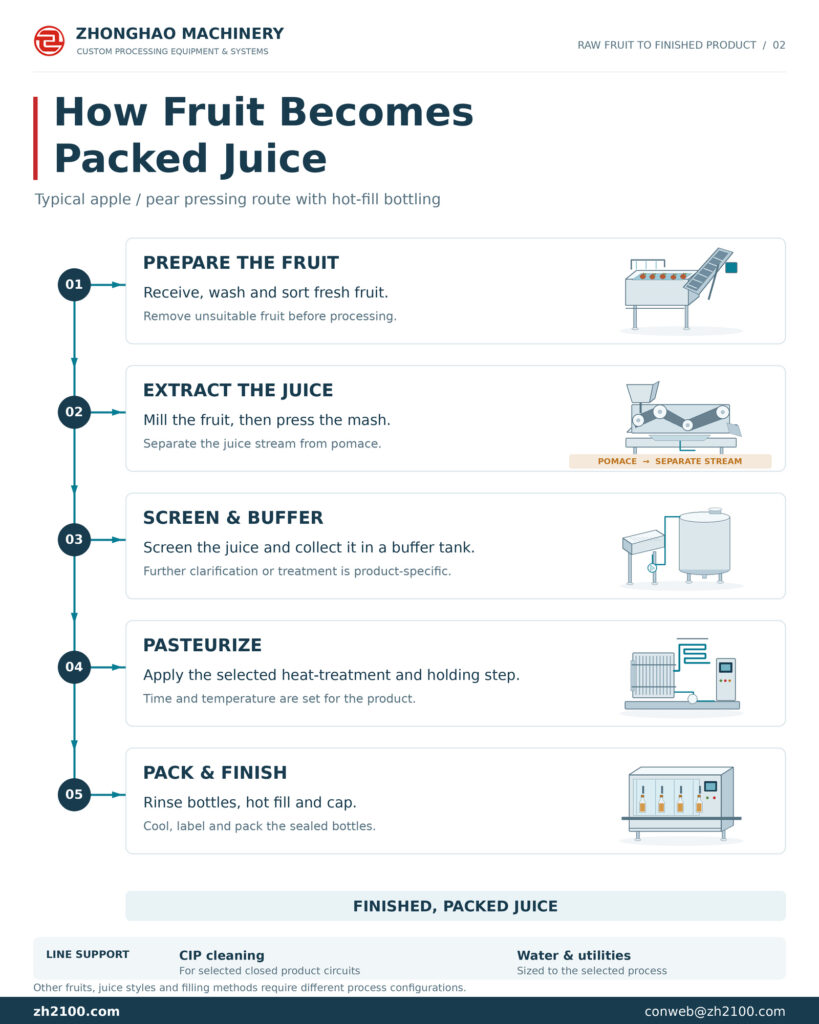
1. Prepare the Fruit
Fruit enters the reception and washing section, then passes through inspection and sorting. The preparation section should suit the incoming fruit condition and the way fruit is delivered to the plant.
2. Mill the Fruit and Extract the Juice
In the illustrated apple and pear route, a mill prepares mash for a press. Juice continues to the liquid-processing section while pomace leaves through a separate outlet. Pomace collection and removal need space in the layout, just as finished-product handling does.
3. Screen, Collect and Transfer
A screen removes coarse material, and an upstream buffer tank helps coordinate juice collection and transfer. Coarse screening does not by itself produce a clarified juice. A clear-juice specification may require additional clarification or filtration. A cloudy product needs a treatment route that preserves its intended character.
4. Apply the Selected Heat Treatment
The pasteurizer must suit the juice properties, required flow and filling method. Heat-exchanger selection should consider viscosity and pulp or particle content. Product-specific process design establishes the treatment and holding conditions; a general equipment diagram cannot define them.
5. Fill, Close, Cool and Pack
This example uses bottle preparation, hot filling and capping, followed by cooling, labeling and packing. Bottle material, closure design, handling and cooling must be compatible with the selected process. Chilled and aseptic filling are separate design routes and can change the downstream equipment.
Does Every Fruit Use the Same Production Line?
The raw material and finished-product specification should be agreed before selecting the extraction section. A line described only as a “juice line” leaves important choices unresolved.
- Apple and pear juice: the milling and pressing example in the diagrams provides a useful starting point.
- Citrus juice: fruit-specific extraction and peel handling call for a different front end.
- Other fruit products: preparation and extraction should be reviewed for the fruit structure and whether the target product is juice, pulp or purée.
- Drinks made from concentrate: the starting point is concentrate preparation, treated water and blending. Fresh-fruit washing and pressing are generally outside that process route.
A mixing tank can be useful for a formulated beverage, but it represents one part of that system. It does not perform fruit reception, extraction or bottle packaging.
How to Size a Complete Juice Line
For a project inquiry, avoid specifying capacity as a single number without a unit or production basis. Three useful figures describe different parts of the line:
- Fruit input in kg/h: the quantity entering the fruit-processing section.
- Juice output in L/h: the liquid flow required through the downstream process.
- Packaging output in bottles/h: the filling target for a stated bottle size.
Fruit input and juice output are linked by the expected extraction result. Bottles per hour depend on fill volume. The project calculation should also allow for operating hours, cleaning, product changes and interruptions. Comparing a press capacity with a filler rating without these assumptions can leave a bottleneck between them.
For example, a requirement stated as “fruit type + finished juice style + target liquid output + bottle size + operating hours” gives the equipment review a much clearer basis than “one complete juice line.”
Supporting Systems to Include in the Scope
Plan the utilities and cleaning approach alongside the process equipment. Confirm available electrical supply, water quality and flow, heating and cooling services, compressed air where required, drainage and waste handling. A layout should reserve access for operators, maintenance and material movement.
Cleaning-in-place (CIP) can serve suitable closed product circuits, with cleaning supply and return paths designed for the equipment involved. Open fruit washers, inspection conveyors and other accessible sections need their own cleaning arrangements. The cleaning scope should identify each circuit and responsibility.
Control requirements should also be explicit: which machines have local panels, which signals are exchanged between units, and who supplies the common controls, connections and commissioning work.
For related equipment planning, see our CIP cleaning system guide and stainless steel mixing tank selection guide.
What Information Is Needed for a Project Inquiry?
Share the following details to make an initial equipment proposal more useful:
- Fruit type, incoming condition and whether production starts from fresh fruit, pulp or concentrate.
- Finished product: clear juice, cloudy juice, nectar or another formulated drink.
- Target input or output, units, daily operating hours and expected seasonal use.
- Bottle or package material, size, closure and target packing speed.
- Intended storage and distribution conditions.
- Available floor space, utilities and any existing equipment to retain.
- Required automation, cleaning arrangements and project destination.
The proposal should identify the included machines, interfaces, utilities and exclusions so that both sides can review what the complete project covers.
Frequently Asked Questions
Can one line process several fruits?
Some equipment may be shared, but suitability depends on the fruits, extraction methods and finished products. List each planned product before assuming that one front-end configuration can cover them all.
Does every juice line need a homogenizer or concentrator?
No. Homogenization is a product-dependent option, and concentration is a separate process requirement. Include either only when the finished-product specification calls for it.
Can the diagram establish shelf life?
No. Shelf life must be established for the actual product, validated process, packaging and storage conditions. It cannot be inferred from a machine list or this conceptual flow.
Discuss Your Fruit Juice Processing Project
Send Zhonghao Machinery your raw material, product specification, capacity and packaging requirements. We can review the process-equipment requirements with you and confirm the proposed configuration and supply scope for your project.
Contact us to discuss your juice processing requirements, or email conweb@zh2100.com.