
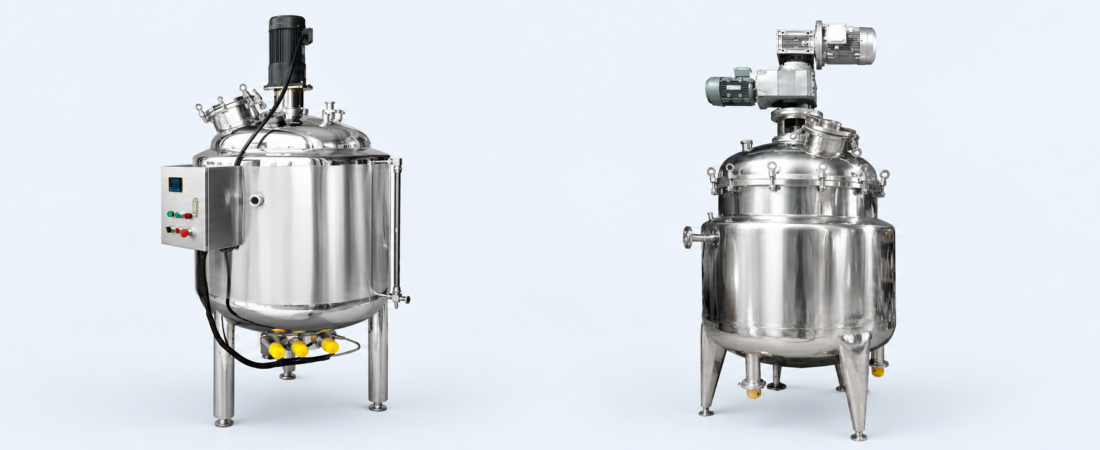
A mixing tank and a reactor can both be equipped with agitators, heating or cooling jackets, vacuum systems and process controls. The key difference is not simply the vessel name, but the process duty. A mixing tank is typically selected when the main objective is blending, dissolving, dispersion or product preparation. A reactor is generally considered when the process requires more tightly controlled temperature, vacuum or pressure conditions, defined reaction time, or a physical or chemical transformation. Final selection should be based on the actual process conditions and required vessel design.
Mixing Tank vs Reactor: Quick Comparison
| Selection Factor | Mixing Tank | Reactor |
|---|---|---|
| Primary Process Duty | Blending, dissolving, dispersion, preparation | Controlled processing or reaction |
| Agitation | Main process function | Part of the overall process |
| Heating / Cooling | Optional, depending on process | Often integrated when process control is required |
| Vacuum | Optional | Used when required by the process |
| Pressure | Depends on vessel design | Depends on process and rated vessel design |
| Process Control | Basic to advanced | Typically more process-oriented and controlled |
Important: Heating, cooling, vacuum or agitation alone does not automatically make a vessel a reactor. Pressure or vacuum operation must also be evaluated against the actual vessel design, operating conditions and applicable requirements.
When Should You Choose a Mixing Tank?
Choose a mixing tank when the main objective is to blend, dissolve, disperse or prepare a product without requiring a defined reaction process. Mixing tanks are commonly suitable for applications where agitation is the primary function and heating, cooling or vacuum are only additional process requirements.
- The main objective is blending or product preparation.
- No defined chemical reaction is required.
- Agitation is the primary process function.
- Heating or cooling is only an auxiliary requirement.
- Vacuum is optional rather than the core process condition.
When Should You Choose a Reactor?
Choose a reactor when the process requires more controlled operating conditions or a defined physical or chemical transformation. Reactors are commonly considered when temperature, reaction time, vacuum, pressure, dosing sequence or other process parameters must be controlled as part of the production process.
- The process involves a defined physical or chemical transformation.
- Temperature or reaction time must be closely controlled.
- Vacuum or pressure is an important process condition.
- Dosing sequence or process steps must be controlled.
- The vessel must support more tightly controlled processing conditions.
Key Factors That Determine the Right Choice
Choosing between a mixing tank and a reactor should be based on the actual process requirements rather than the equipment name alone. Product characteristics, temperature, vacuum or pressure, mixing purpose and the required level of process control all influence the final vessel configuration.
1. Product Characteristics and Viscosity
Product viscosity, solids content and flow behavior directly affect agitator selection, motor power and vessel design. Low-viscosity liquids may only require simple blending, while high-viscosity products can require stronger agitation, different impeller designs or additional shear equipment. These factors should be evaluated before deciding whether a standard mixing tank or a more process-controlled reactor configuration is appropriate.
2. Heating and Cooling Requirements
Heating and cooling requirements affect jacket design, heat-transfer area, utility selection and process control. If temperature adjustment is only needed to assist mixing or product preparation, a mixing tank may be sufficient. If the process depends on maintaining a defined temperature profile or controlling heating and cooling during a reaction or transformation, a reactor configuration may be more appropriate.
3. Vacuum and Pressure Requirements
Vacuum and pressure requirements must be evaluated carefully because they directly affect vessel design, sealing, safety devices and operating limits. If vacuum is only used occasionally to remove air or support product preparation, a mixing tank may be suitable if it is designed for that condition. If the process depends on controlled vacuum or pressure as a core operating requirement, a reactor or specially designed vessel may be more appropriate.
4. Mixing Purpose and Agitator Type
The required mixing result determines the agitator type, speed and power. Simple blending may use a conventional impeller, while dissolving, dispersion or high-viscosity processing can require different agitator designs or additional high-shear equipment. The mixing objective should be defined before selecting the vessel configuration.
5. Process Control and Automation
The level of automation should match how tightly the process must be controlled and repeated. A simple mixing tank may only require motor speed control, temperature indication and basic level monitoring. More complex reactor processes may require coordinated control of temperature, agitation speed, vacuum or pressure, timed dosing, alarms and recipe steps through a PLC/HMI. The control system should be defined from the actual operating sequence rather than added after vessel selection.
6. Process Sequence and Dosing Requirements
Process sequence and dosing requirements can determine how simple or complex the vessel system needs to be. If ingredients are added in a straightforward sequence and only basic mixing is required, a mixing tank may be sufficient. If the process requires timed dosing, controlled addition rates, multiple process stages or specific temperature and mixing conditions at each step, a reactor or more integrated process system may be more appropriate.
Typical Applications: Mixing Tank vs Reactor
Typical applications can help narrow the equipment choice, but the final selection should still be based on the actual process conditions. The same industry may use either a mixing tank or a reactor depending on viscosity, temperature, vacuum or pressure, mixing intensity, dosing sequence and process control requirements.
| Application | Mixing Tank | Reactor |
|---|---|---|
| Food & Beverage | Blending, dissolving, ingredient preparation | Controlled heating, vacuum or multi-step processing |
| Cosmetics & Personal Care | Mixing, dispersion, product preparation | Vacuum processing, controlled heating or reaction-sensitive formulas |
| Chemical Processing | General blending and formulation | Controlled reaction, temperature, pressure or dosing sequence |
| Pharmaceutical & Biotech | Preparation and blending where applicable | More tightly controlled processing and defined process steps |
| General Industrial | Simple mixing and liquid preparation | Processes requiring tighter operating control or complex sequences |
What Information Should You Send Before Equipment Selection?
To recommend the right mixing tank or reactor configuration, the equipment supplier needs more than the product name or required capacity. Basic process information helps determine vessel size, agitator type, heating or cooling method, vacuum or pressure requirements, material selection and control system.
- Product or material to be processed
- Batch capacity or working volume
- Product viscosity or flow characteristics
- Required process temperature
- Heating and cooling requirements
- Mixing purpose and required mixing result
- Vacuum or pressure requirements
- Automation and control requirements
Common Mistakes When Choosing Between a Mixing Tank and Reactor
Many selection problems occur because the vessel is chosen by name, appearance or capacity before the actual process is understood. Avoiding the following mistakes can reduce unnecessary cost, prevent unsuitable configurations and make equipment selection more accurate.
1. Choosing Equipment Only by Capacity
Capacity alone is not enough to select the correct vessel. A 1,000 L tank used for simple liquid blending may require a very different configuration from a 1,000 L vessel used for high-viscosity processing, heating, vacuum operation or a controlled reaction. Working volume, product characteristics and process conditions should be confirmed together.
2. Assuming Heating or Vacuum Automatically Means a Reactor
Heating, cooling or vacuum functions do not automatically make a vessel a reactor. A mixing tank can also be designed with a jacket, vacuum capability or temperature control when the process requires them. The correct classification depends on the overall process duty, operating conditions and vessel design rather than on a single feature.
3. Ignoring Product Viscosity and Mixing Difficulty
Product viscosity has a major effect on agitator type, motor power, mixing time and overall vessel configuration. A low-viscosity liquid and a high-viscosity cream may have the same batch volume but require completely different mixing systems. Viscosity, solids content and the required mixing result should be confirmed before the agitator and vessel are selected.
4. Selecting the Vessel Before Defining the Process Sequence
The vessel should not be selected before the process sequence is clearly defined. Ingredient addition order, mixing stages, heating or cooling steps, holding time, vacuum or pressure conditions and discharge requirements can all affect the final equipment configuration. Defining the process first helps avoid unnecessary features or missing functions.
5. Overlooking Cleaning and Maintenance Requirements
Cleaning and maintenance requirements should be considered during equipment selection, not after the vessel is built. Product contact surfaces, internal access, agitator design, seals, drainability and cleaning method can all affect the final configuration. For processes with frequent product changes or higher hygiene requirements, cleanability and maintenance access should be confirmed before the vessel design is finalized.
6. Adding Automation Before Defining the Process
Automation should be designed around a clearly defined process, not used to compensate for an unclear one. PLC/HMI control can manage temperature, agitation speed, dosing, vacuum or pressure and process timing, but only after the required sequence and control points are known. Defining the process first helps avoid unnecessary automation cost and makes the control system easier to operate and maintain.
FAQ: Mixing Tank vs Reactor
1. Can a Mixing Tank Be Used for Heating or Vacuum?
Yes. A mixing tank can be designed with heating or cooling jackets, temperature control and vacuum capability when required by the process. However, the vessel must be designed for the actual operating conditions. Heating or vacuum alone does not automatically make the vessel a reactor.
2. What Is the Main Difference Between a Mixing Tank and a Reactor?
The main difference is the process duty. A mixing tank is primarily used for blending, dissolving, dispersion or product preparation, while a reactor is generally used when the process requires more controlled conditions, defined reaction steps or physical or chemical transformation.
3. How Do I Know Which Agitator Type I Need?
The agitator type depends on product viscosity, solids content, batch volume and the required mixing result. Simple blending, dissolving, dispersion and high-viscosity processing may require different impellers, speeds and motor power. The process information should be reviewed before the agitator is selected.
What Information Should I Provide for Equipment Selection?
Please provide the product or material, batch capacity, viscosity, required temperature, heating or cooling needs, vacuum or pressure conditions, mixing purpose and automation requirements. The more complete the process information is, the more accurately the equipment configuration can be selected.
Need Help Selecting the Right Mixing Tank or Reactor?
If you are not sure whether your process requires a mixing tank or a reactor, send us your product information, batch capacity, viscosity, operating temperature, heating or cooling requirements, vacuum or pressure conditions, mixing objective and automation requirements. We can review the process conditions and help define a suitable vessel, agitator and control configuration for your application.
Request Equipment Recommendation